
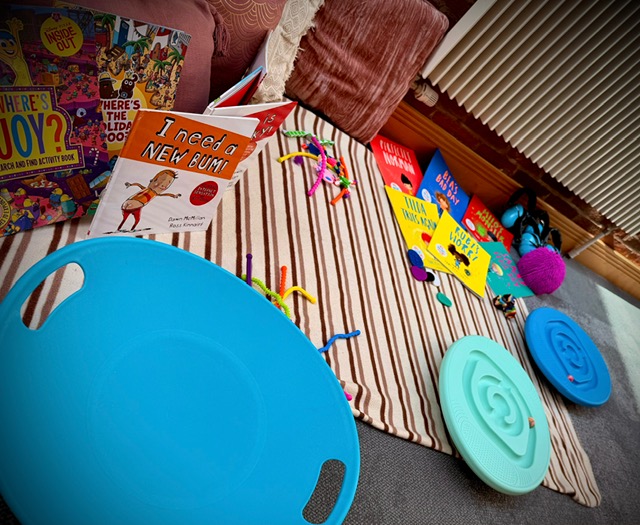
Sensory-Friendly Studios: Look at your studio through a child’s senses
We walk into our dance studios every week and barely notice the environment around us.
The lights go on. The music starts. Children are chatting. Teachers are giving instructions. Dancers are moving in the mirrors.
To us, it feels like a normal dance class.
But for a child with sensory processing differences, that same environment can feel very different.
So this lesson is really simple:
Stop and experience your studio through a child’s senses.
💛 Free Resource for Dance Teachers
Looking to make your dance school more inclusive?
Download our FREE ‘10 ways to make your dance school more inclusive’ and explore changes you can make that create a big impact – The perfect starting point for dance schools wanting to create environments where every child belongs.
🎵 Music
Does the music need to be at full volume while you’re teaching? Could you turn it down while giving instructions and increase it when the children actually dance?
🪞 Mirrors
Mirrors create a huge amount of visual information, people moving, reflections, lights and activity behind the child. Could a dancer who becomes overwhelmed occasionally face away from them or choose a quieter position in the room?
💡 Lighting
Bright or harsh overhead lighting can be uncomfortable for some children. We can’t always change the facilities we hire, but simply being aware of lighting and avoiding unnecessary flashing or changing lights can help.
🤝 Touch
Physical correction is common in dance, but touch can be uncomfortable or unexpected for some children. Try asking first:
“Can I move your arm to show you?”
That tiny question gives a child autonomy over their own body.
👗 Uniforms & costumes
Tights, sequins, labels, elastic, hair accessories and stage make-up can all create sensory challenges.
Sometimes relaxing a uniform expectation or making a small costume adjustment can be the difference between a child being able to participate and not.
🔊 Background noise
It’s not only the music. Tap shoes, children talking, teachers projecting their voices, doors opening, parents outside and another class next door can all contribute to sensory overload.
And here’s the important part…
A sensory-friendly studio doesn’t have to be a quiet studio.
We’re teaching performing arts! There will be music, movement, excitement and noise.
Final Thoughts
The goal isn’t to remove every sensory experience.
It’s to notice potential barriers and be willing to adapt when a child needs us to.
Looking for more practical inclusion support?
Explore our Inclusion Guides, Inclusion Support Calls and BELONG Accreditation to help create dance schools where every child belongs and every child can shine.
Because inclusion isn’t an extra — it’s essential.
Thanks for reading,
Katie x